Category Archives: Mortgage guidelines

Two for Tuesday – Two Exceptions to DTI

Two for Tuesday, for the love of FHA.  And the “I gotta guy” questions I get all the time. When you run DU and it doesn’t approve the loan, but gives you options to refer to manual guidelines.  Here’s the tips for DTI exceptions on manual underwriting for FHA.

#TwoforTuesday

Two for Tuesday – LP & USDA

Some great announcements on new guidelines for the two products.  For the love of GUIDELINES today!  Two for Tuesday! #SellWell #LoveyourBrokerday

Happy Valentine’s Day

Two for Tuesday – Student Loan Guides

Two for Tuesday going over the newest guidelines on Student loans for 2017!

Two for Tuesday!

Yep there coming back, and next week the new video’s start.  Want to see a cheat sheet for DTI associated with FHA loans.  Click the link below.  While I made the video a year ago, the same concepts still apply.  Plus DU was just reprogrammed again.  Give your feedback on what DTI is giving as results, is it more sensitive to DTI in 2017 already?  QM exemption is coming to an end for GSE’s. And during the Trump reign we’ll see GSE’s have to conform to the 43% rule.  Remember they were only exempt for 7 years when it all started.  That means more scrutiny to DTI in the near future.  Great idea to start conforming and not just over extending your pre-approval letters to the max.  Make it so clients can buy a house and live.  #ThemortgageJuiceman

#TwoforTuesday

Who needs a change? Non QM products?

We all do, as all change should be viewed as good, and should be embraced.  I have some great news for my business partners, and anyone originating mortgage loans.  I have partnered with a new wholesale lender that offers a WAVE of new products on the NON QM market side, and provide all the agency loans your used too with NO OVERLAYS!!.

Manual underwriting and manufactured properties available on all products.  Even a 1st/2nd combo (Double WAVE) loan that goes up to 1,125,000.  NO DOC investor loans are back, up to 75% LTV.   1 Year self employed program, and 12-24 month BANK STATEMENT programs are available.  A 70% LTV Foreign National program, and a program that requires NO SEASONING on BK’s/Foreclosures and Short Sales.  WOW!  And the list goes on…

85% LTV with a 560 FICO up to 2 Million.  Yep your reading this right.  THE LOAN WORLD IS ABOUT TO GET JUICY!  A program that allows for 60% LTV on loan amounts greater than 1 Million with a  500 FICO!  Did I mention 80% LTV on a non owner occupied home with 12 month Bank Statements?  Up to 2 Million.  There is even  a program up to 90% LTV on a bank statement program available.

In all my missions I have in life I carry the passion and excitement to help others. This specifically helps me partner with Broker’s and relationships I’ve had for over a decade in this industry.  The Mortgage Juice is flowing, come Join Us In Creating Excitement.  Accepting resumes for sales candidates and Broker packages now!!

I can’t wait to help you close more loans.  Happy Originations – The Juiceman


Qualified Mortgage (QM) 3 points to remember

Well here we go again, DU is about to be updated again in June this year from what I hear.  Again we see the implementation of QM rules into the approval engine.  Ever notice how every 6 months or less now, DU is being updated?  Let me explain why again.

QM is making all loans backed by the Government Sponsored Entities eventually be 43% DTI too.  They were/are just exempt from that rule for 7 years.  It will be hard to fathom for some that do FHA/VA loans at north of 50% DTI all the time, that they will be capped at 43% in a very short time.  QM is half way through that 7 year period.  And every time DU is updated it is lowering the risk thresholds on DTI.  Ever notice that?

Well there’s more to the story.  In the next two years mark my word.  Correspondent “Lenders” are going to be regulated heavily.  More and more “skin in the game” reserve requirements will come to the land of mortgage lending.  It will more than likely require a fraction of a fraction of the overall business generated and funded monthly to be kept as reserves by that mortgage company.  More regulation for compliance of those “mini-correspondents” of the world will force them back to the “broker world”.   I see this trend now, more correspondents are going back to “brokering” to avoid compliance tasks.  There was a trend in emerging correspondent lenders since 2010, and now that the disclosures are the same on the front end as banks, that trend I see reversing itself as new regulations come to play in the next few years.  Yeah, you can still make front end and back end, but you still have to be at 3% total QM fees.  This is what I see happening, and of course not factual yet I do not think.  If your not closing north of ten million on your own lines per month it may not be worth it.  The dollar amount in fees and interest just to use the line makes it that your break even point may be around that same 2.75% that could be “brokered”.   Heck that break even point may be a higher funded volume.  And if new laws come to play that make a mini-correspondent hold more skin in the game as reserves, that extra “monies” is going to have to be held.

Now the third point.  The 3% rule.  I see it all day just because I do the math in my head so fast.  But LO’s you need to do this too.  For example, know what goes INTO the QM and then do the “math backwards”.  Commission, Underwriting fees, Points (unless bona-fide), Affiliated arrangement profit.  So if you are not affiliated with any AMC etc, and you “waive” or “buy out” the underwriting fee, then the only two things to LOOK at would be your compensation plan plus any points if any.  Now you can bona-fide 1 discount point if you have a rate that isn’t the top rate on the rate sheet or the bottom rate on the rate sheet.  Important to remember.  So if you are lending at 2.75% comp plan, and you have a final price of 97.5 after all add-on’s, you ARE going to run into an issue.  2.75% plus one bona-fide point would put you at 99 net pricing, and you would only have about a .25 or so left.  Not even.  So at that rate you could be at about 98.85 based on my estimation buying out the underwriting fee, charging 2.75% and bona-fide one discount point.   NOT 97.5% on final net pricing.  Do the math when  you lock.  Just cause the the rate’s on the rate sheet in most cases you can’t even offer that rate with a 2.75% comp plan and still pass QM 3% rule.  Know this in advance.

Here’s an insert from an article that quotes the concepts I was mentioning, made in JAN 10th 2013….CFPB Releases Final Rule on Ability to Repay, Leaves Back Door Open on DTI

“CFPB concedes there are instances where a debt-to-income ratio above 43 percent may be appropriate based on individual circumstances but believes these loans should be evaluated on a case-by-case basis under the ability-to-repay criteria rather than with a blanket presumption. Given the fragile state of the mortgage market however CFPB is concerned that creditors may initially be reluctant to make loans that are not qualified mortgages, even though they are responsibly underwritten. The final rule therefore provides for a second, temporary category of qualified mortgages with more flexible underwriting requirements so long as they satisfy the general product prerequisites for a qualified mortgage and are also eligible to be purchased, guaranteed or insured by the GSEs (while under conservatorship), HUD, The VA, or The USDA. This temporary provision will phase out as these agencies issue their own qualified mortgage rules, if GSE conservatorship ends, and in any event after seven years.”

QM Simplified

Sell Well – JUICEMAN

TRID still affecting you? Blast from the past that speaks the truth about TRID.

A Broker in Cali, that I have in my network asks me today;

How does TRID really affect me and what do I really need to know?

My answer is 3 parts of importance for you to know on how it changes the way the Mortgage Broker does business now.

1. The way Broker’s can switch lenders in doing business now changes.  The thing to know is the GFE and the TIL are combined.  So the fact the GFE isn’t signed now and it’s easy for brokers to “switch” lenders will change.  You will now need to “create” a new GFE if you are switching lenders assuming comp plans are different or the fee’s are different.  Then the borrower would need to sign that new LE (Loan Estimate). **re-post notes.  This is why the “Broker is bouncing back”.  The new disclosures level the playing field and Bank and Broker disclosures in the initial LE all look the same.  More and more rules are coming that will make more “mini-correspondents” have more reserves and mandate licensing etc if they “lend”.  Even more compliance laws to roll out in the next two years is what I see.  Why being a “wholesale Broker” is the way to go.  More new business starting daily.

2. The Tolerance items on the GFE as it is now are changing.  This could be a big movement in the industry.  And we could see “more” upfront fees on LE than we do on the GFE now a days.  The shopper will have a handle on Brokers that go skinny in the fees.  You know how the transfer taxes and owners title are a “ZERO Tolerance” item…. well guess what that section of the “LE” or new GFE if you will, is changing to include more items.  Pretty much all the items in box 3 right now.  What that entails is the Credit Report fees, the Appraisal fees, Tax Service fees, Flood Cert fees.  So, better make a new BEST PRACTICE as a Loan Originator in my opinion.  At the beginning you should disclose the cost of an appraisal and 1004D upfront at least.  Better disclose the credit report fee and at least two credit sups upfront.  Hope to see Flood cert’s and Tax Service fees more common on the new LE as well.  These would be mandatory to disclose in my mortgage company if I owned one.  Because if your fee’s end up 1 dollar more we all know that the 1 dollar becomes a Broker cure on the difference and shorts your income. **re-post notes; This is why companies are hesitant to send out CD’s in advance of CTC.  Continue to read 3.

3. The act that I preach now to all my network about “creating a HUD1” out of calyx or encompass after verifying fee’s is going to be a big deal.  At the end of the process under TRID there is a new disclosure called the CD (Closing Disclosure) that goes out and you have to wait 3 days from acknowledgement to get docs.  SO, that means no last minute changes.  About the time the loan is CTC’d Broker’s should be verifying fees from Title/Escrow and then having processors verify all those fees and structure with a HUD1 you create out of Calyx/Encompass/Byte etc.  Again the point is changes will delay loans and burn locks.  So it is important for all loan originators to adopt a new process that verifies structure and fees on a loan prior to closing.  Like a week before.  As the last conditions are sent in.

There are a few other changes Broker’s should know about, read about the full changes don’t go uneducated on how these changes will affect you.  Happy Originations.

**Re-post notes; You still seeing the affect of TRID or are you closing loans fast again?  If not call me I can help.

– JUICEMAN

Tax Week Q&A!

The week of April 15th is tax week, and the dawn of tax refund special advertising.  It’s funny how this week I can almost bet that you see a furniture commercial advertising they will pay your sales tax, or perhaps a car dealership will match your down payment if you use your tax refund with them.  There are a ton of marketing spins to this during this the week of April 15th.  Rightfully so too, and great advertising.  Taxes owed and filing have a big impact on certain financing.  Such as a home.

What does this mean when buying a big ticket item like a house?  Well with Fannie and Freddie conventional loans having to owe taxes is not necessarily grounds for disqualifying you from buying a house.  If you owe taxes this year set up a payment plan, and once approved make a payment or two.  Now Fannie and Freddie do not say you need to make a payment, but FHA does.  FHA now says you have to have a payment agreement and pay 3 months of that agreement to be eligible.

What if I owe back taxes or have an IRS lien?  Yes you still need to have an agreement in place for FHA and three months payments made on it.  If you are attempting to do a conventional loan then you will be stuck having to pay off the back taxes if they are a true tax lien.  If they do not have a lien yet, but they owe back taxes that client should definitely be able to show an agreement and a payment history on that previous years taxes at this point.

What happens if I don’t close my loan on April 15th?  Well the clients’ should have transcripts from the IRS showing they filed taxes hopefully.  IF NOT, an extension is ok to have in the file now.  From April 15th to Oct 15th is the window in which any file can close using the previous two years taxes as verification if a tax extension was filed by an individual.  During that time you just have to have a copy of the filed extension in the file.

What if they just Filed taxes this weekend (week of April 15th) for example, how soon can we close?  Great question if the wage earner on the loan is in fact W2’d and income is not more than 25% commission, we can do a W2 Validation only loan.  The transcripts we get back as lenders is verification of the employer filing the W2 not the client.  So we wouldn’t have any down time.  If the client was paid all commissions or self employed and just files this week, well then your probably going to end up waiting a month or two… I only say that because the transcript results of someone verifying a clients filed taxes come based on the IRS turn time of getting them in that system.  And on the busiest week of the year for the IRS, the odds that it’s just going to take 3-4 weeks will be slimmer.  I’ve always experienced a surge in turn time being a lot longer for those that need transcripts in a loan but they just filed at the week of April 15th.  Try like 6-8 weeks out for them to show up.  Plan accordingly.

Sell Well – JUICEMAN


The ART of pushing the Bruise

In every sales there is an angle to walk a client through their pain.   The key is bridging the gap, to help the client understand YOUR value.  In originating mortgages one of the key conversations I would have with each client was a review of their credit report.  In car sales the same thing, in selling vacuum cleaners door to door it was the spots that had stains that would never come out.  My point is every sale somewhere has an angle that can be pushed to bridge the gap of a need or want for your product or service.

In mortgage origination or even in referral business partnerships the ability to help a end user or client relationship see your value is in bridging that gap of the pain.  Most people have a some blemish on credit, or value you can create by educating them on an item on their credit.  The ART of pushing the bruise a little to help show your value is really part of selling itself.  It helps add to your SOLUTION that you can pitch.  Your solution to the problem or pain that you point out helps pull in the benefit from all the features you have.  It bridges the gap and helps walk them through the pain in a nice way that can differentiate you from the competition.  If you pull credit with a borrower and then just look at the FICO and move on your doing it all wrong.  In fact the review of a credit report with someone in almost any financial service should be an important part of the conversation.

Push the bruise as to why they have the spending habit’s they do, and provide a solution.  When I originated each person I talked too as I took an application got a “free” credit analysis/review and would leave the conversation knowing more about their credit and what to do and what not to do even if I could not do a loan.  Those are the people that referred me to others even though we didn’t do business.  If your not having at least a 10 minute call going through each line item and asking about the credit items on credit to help a client know more education on their financial report card, your missing a part of the sale.  Car sales, mortgage sales, heck anything that involves you pulling a credit report.

Some tips I’ve learned along the way about credit that I went over with everyone I talked too:

  1. Review the FICO and let them know all three scores. Below the FICO score is typically codes you can go over with them that highlight the reason’s they are being marked down.
  2. Think JUMBO guidelines.  Credit is an evaluation of how you manage debt, not that you pay off a bunch of cards every month.  So the best FICO’s typically have a history of having 2 installment loans, (1 mortgage/1 car), and at least 3 other trade lines that are revolving.
  3. Revolving debt and the way a FICO is established.  The key again is to show the bureau’s you know how to manage debt.  So when you have a line of credit of 1000 you should be always 50% or less revolving from month to month.  The minute you go above that ratio your score is marked down.  In fact where you want to be is 30% or less of the overall line limit from month to month and you can actually increase your score.  You can hurt your score paying it off every month, as that doesn’t show the bureau’s you are managing a balance.
  4. The pulling of credit in the financial arena doesn’t affect a FICO IF… that is IF that person whom pulls credit is registered as a financial spot for Car or Mortgages.  There is a shoppers law that is out there.  Not so sure the exact name of this, theory or law, but it exists.  And it has to do with protecting a client that wishes to “shop” for a car loan or mortgage loan.  If that vendor is registered as a financial institution and more than one pulled a credit report within a two week period (may have changed) then that pull is looked at as one pull affecting the FICO, not multiple ones.  This is where it differs from Banks to Broker’s I’ve found in that Broker’s can sometimes have a different vendor code that doesn’t recognize them as a financial institution and that affects their score being pulled every time.  Again consult your vendor for the credit pull on how your credit inquiries are labeled.

Just by going over these simple things and educating a client, not only verifying the debt, it can be a way to help uncover a need or want that you can potentially fulfill.  This is the art of pushing the bruise, and later in your pitch that you can help them see value in what you’ve done or going to do for them.

Sell Well – JUICEMAN

How to use a mortgage to help develop wealth

How do you use a loan against a property to develop wealth?  I say at least 4 ways…

More and more people are in need of understanding how to leverage their efforts to build more wealth.  There is a story out there of the “two brothers”, whom one gets a big fat 30 year fixed loan and the other gets a 15 year mortgage.  Over time the one brother with a 15 year pays his house off, whereas, the other brother never does, he utilizes his money to make money.

First of all, those that think a short term is best, keep in mind that you are actually losing your purchasing power by tying up your DTI (debt to income) ratio with a larger payment.  Where the lower the payment due to the longer term allows you to “afford” more stuff, be a car, boat or other homes.

Second, knowing some lending guidelines can help the average Joe investor.  You see, when you get more than 4 financed properties in a portfolio your lending rules change.  So, if you have 5 financed properties you can NOT do a cash out on any investment properties.  (well you can, it’s called delayed financing and only available within the first 6 months you buy the house CASH)  If your in that position, it’s my advice you get a LLC formed and start putting those homes in a business portfolio and freeing up your personal credit again.

Third, the average JOE American will actually have 4-7 mortgage’s in their life.  Most people that get a 30 year mortgage as a purchase loan do NOT keep that loan for 30 years.  One of the major advantages of having a mortgage is the tax deduction on mortgage interest, but most know that.  The second is how to utilize the mortgages you do.  Let me paint the picture.  Mortgage loan number 1 is obviously to buy the home.  Mortgage loan number 2 is typically within the first 5 years where someone refinances to “save money”.  Mortgage loan number 3 is typically for debt consolidation as a cash out loan.  Mortgage loan number 4 is to potentially eliminate private mortgage insurance and save money again.  Mortgage number 5 or more, could be to recast or reset the mortgage to a new 30 year fixed just to have a small 60-75k mortgage for tax deduction purposes.

In conclusion on the story of the two brothers, the one that paid his house off and then started his major push to build wealth generated less portfolio net worth than the other brother.  The one brother that didn’t take a big payment allocated his money to other investments along the way and created more wealth in life in other assets.  From buying other houses to even investing more in retirement.
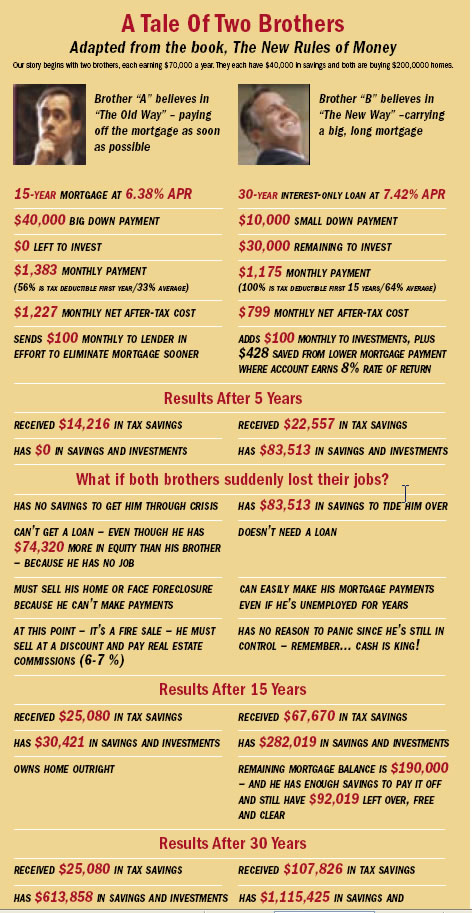
taletwobrothers

In conclusion on illustrating this, a mortgage is a wealth building tool and you just don’t call a mortgage loan officer to “lower your rate”, a mortgage should be custom tailored to help you BUILD wealth.  And if some client is calling you today just asking for your rate and not willing to have a conversation with you or let you pull their credit, they are missing the boat.  Show them the link to the tale of two brothers and have them call you back once they read it.  GOOD loan officers should look at the full financial situation and goals of the individual to know what makes sense to help a client reach those goals.  IF anything.  And sometimes for those knowing they are moving in the next 1-3 years should actually do nothing.  My Dad is a perfect example, he bought everything I ever sold from Cutco knifes to what ever widget I sold, but when I originated mortgages, especially interest only loans he was against them.  Until one day my Sister was in need of money for her wedding.  He came to me and I advised him to take the biggest home equity line he could, and he did, he turned the whole mortgage to an equity line.  And he was the type that was ALWAYS against ARM’s (adjustable rate mortgage) and Interest Only loans.  He took advantage of where the market was in the last 7 years or so and has paid the same amount on the mortgage for years.  Due to him doing this, not only did he get the cash to pay for my Sisters wedding but he’s paid less in interest and owes less now on the home than if he had stayed where he was.  He accelerated his principle payments through his own discipline.  And recently just did his 5th loan, where he refinanced it all on to a fixed 30 year now just to have a small payment and interest to write off.  Loan officers that actually present themselves this way to help custom tailor a mortgage to help a client reach life goals will not only get more referrals but will do more loans.

Sell Well – Juiceman

Tale of two Brothers